

A monitor arm is the single accessory that turns a sit-stand desk into a usable workstation. The factory stand that ships with a screen usually gives you about 4 to 6 inches of height adjustment, while moving from seated to standing typically needs the screen 4 to 8 inches higher. Without an arm, your display stays where the manufacturer put it. That is the core of this guide to the best monitor arms for standing desks: which arm gives your screen the travel it needs, survives a desk that moves every few hours, and still fits the desktop you already own.
Everything below is built on published manufacturer specification data and the themes that show up repeatedly in buyer reviews, checked on September 30, 2026. We did not physically test these arms, and we say so plainly rather than implying a lab we never ran. What we did do is read the load ranges, the mounting hardware, the desk thickness limits and the reported complaints for each arm, then line them up against the situations people actually run into on a standing desk.
If your standing desk doubles as a bike desk or you already ride through your workday, our guides to the best standing desk bikes and best cycling desks cover the frame side of the setup. The display side is what follows.
Table of Contents
- Do Monitor Arms Actually Work With Standing Desks?
- Top 3 Picks for Best Monitor Arms for Standing Desks (October 2026)
- Best Monitor Arms for Standing Desks in 2026
- 1. VIVO STAND-V002 Dual Monitor Mount – the one most standing desks end up with
- 2. HUANUO FlowLift Dual HNDS6 – the best value for two 32-inch screens
- 3. VIVO STAND-V011 Extra Tall Pole – the most sit-to-stand travel on a single screen
- 4. WALI Ultrawide Arm GSM001XLN – 33 lb capacity for large curved panels
- 5. HUANUO FlowLift Single HNSS6 – the easiest first arm to install
- 6. HUANUO Monitor and Laptop Arm HNCM2 – one clamp, two devices
- 7. ErGear EGDMA69B – the budget single arm with tool-free VESA mounting
- 8. Amazon Basics Gas Spring Dual Arm – independent tension for mismatched screens
- 9. VIVO Premium Gas Spring STAND-V001Q – one-hand movement in an aluminum frame
- 10. ULTRARM Heavy Duty MA20P-S – 44 lb capacity for 49 and 57 inch panels
- How to Choose a Monitor Arm for a Standing Desk
- Check the VESA pattern before anything else
- Why the minimum weight rating matters as much as the maximum
- Gas spring or mechanical tension spring
- Clamp vs grommet mount on a standing desk
- Desktop thickness, underside clearance and soft wood tops
- Cable slack for the full lift of your desk
- Matching two unequal monitors to one dual arm
- Test the fit inside the return window
- Frequently Asked Questions
- Which Monitor Arm Should You Buy?
Do Monitor Arms Actually Work With Standing Desks?
Yes. A monitor arm works better on a standing desk than on a fixed one, because the screen is the one thing on the desktop that has to travel with you. The arm clamps to the desk edge or bolts through a grommet, and the display follows the surface up and down instead of staying at one height. A factory stand gives roughly 4 to 6 inches of adjustment; standing usually calls for 4 to 8 inches more.
Before you buy, run this checklist:
Measure your monitor’s weight without the factory stand, then add the weight of any VESA adapter.
Confirm the weight sits inside the arm’s per-arm range, not just under the maximum.
Measure desktop thickness and check it against the clamp opening range.
Look underneath for a control box, frame rail, drawer, cable tray or beveled edge at the mount point.
Count your VESA pattern, usually 75x75mm or 100x100mm on consumer screens.
Plan cable slack for the full lift range of your desk, which commonly runs 20 to 28 inches.
Decide clamp or grommet based on what is under the desktop, not on which is cheaper.
The order matters. Weight and VESA decide which arms are candidates at all, and the underside inspection decides which of those you can actually mount.
Top 3 Picks for Best Monitor Arms for Standing Desks (October 2026)

VIVO STAND-V002 Dual Monitor Mount
- Two screens to 30 inch
- 22 lbs each
- VESA 75x75 and 100x100
- C-clamp to 3.25 inch
- 3 year warranty
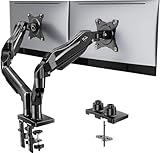
HUANUO FlowLift Dual HNDS6
- Two screens to 32 inch
- 4.4 to 19.8 lbs per arm
- Raises screens 15.75 inch
- 5 year warranty

VIVO STAND-V011 Extra Tall Pole
- 39 inch pole for sit-to-stand travel
- Holds 22 lbs and 38 inch ultrawides
- C-clamp to 4 inch
- 3 year warranty
As an Amazon Associate we earn from qualifying purchases. CERTAIN CONTENT THAT APPEARS ON THIS SITE COMES FROM AMAZON. THIS CONTENT IS PROVIDED 'AS IS' AND IS SUBJECT TO CHANGE OR REMOVAL AT ANY TIME.
Best Monitor Arms for Standing Desks in 2026
| Product | Key Features | Action |
|---|---|---|
|
VIVO STAND-V002 Dual Monitor Mount
|
|
Check Latest Price |
|
HUANUO FlowLift Dual HNDS6
|
|
Check Latest Price |
|
VIVO STAND-V011 Extra Tall Pole
|
|
Check Latest Price |
 WALI Ultrawide Arm GSM001XLN
|
|
Check Latest Price |
 HUANUO FlowLift Single HNSS6
|
|
Check Latest Price |
 HUANUO Monitor and Laptop Arm HNCM2
|
|
Check Latest Price |
 ErGear Single Monitor Arm EGDMA69B
|
|
Check Latest Price |
 Amazon Basics Gas Spring Dual Arm
|
|
Check Latest Price |
 VIVO Gas Spring Single STAND-V001Q
|
|
Check Latest Price |
 ULTRARM Heavy Duty MA20P-S
|
|
Check Latest Price |
As an Amazon Associate we earn from qualifying purchases, at no additional cost to you. CERTAIN CONTENT THAT APPEARS ON THIS SITE COMES FROM AMAZON. THIS CONTENT IS PROVIDED 'AS IS' AND IS SUBJECT TO CHANGE OR REMOVAL AT ANY TIME.
1. VIVO STAND-V002 Dual Monitor Mount – the one most standing desks end up with
VIVO Dual Monitor Desk Mount, Holds 2 Computer Screens up to 30 inches and 22lbs Each, Heavy Duty Fully Adjustable Steel Stand with C-Clamp and Grommet, Black, STAND-V002
Two 13-30 inch screens
22 lbs per arm
VESA 75x75mm / 100x100mm
C-clamp to 3.25 inch
Pros
- Holds two 13-30 inch screens at 22 lbs each
- 90 degree tilt with 180 degree swivel and 360 degree rotation
- Portrait and landscape orientation
- Heavy-duty C-clamp grips desktops up to 3.25 inches thick
- Cable management clips along arms and pole
- 3 year manufacturer warranty
Cons
- Height changes happen on the central pole rather than at the arm joint
- Fixed pole design gives less lateral reach than a fully articulating arm
- Clamp can conflict with a support beam directly under the mount point
As an Amazon Associate we earn from qualifying purchases, at no additional cost to you. CERTAIN CONTENT THAT APPEARS ON THIS SITE COMES FROM AMAZON. THIS CONTENT IS PROVIDED 'AS IS' AND IS SUBJECT TO CHANGE OR REMOVAL AT ANY TIME.
The VIVO STAND-V002 is the arm we recommend first for most standing desks, and the reason is unglamorous: it has been built and sold for a long time, it has the largest review base of anything in this roundup, and it does the two things a sit-stand desk actually demands. It holds two screens at up to 22 lbs each without sag, and it clamps to desktops up to 3.25 inches thick without a fuss.
Buyers consistently point at the steel construction and the straightforward installation. Two mid-size screens stay where they are put. The movement range is wide enough for real desk work, with plus and minus 90 degree tilt, 180 degree swivel and 360 degree rotation, and the VESA plates detach if you need to swap a panel.
The trade-off is mechanical in nature. Height adjustment happens along the center pole rather than at the arm joint, so changing screen height means loosening bolts instead of moving a counterbalanced arm with one hand. On a desk that moves twice a day, that is a small friction you will feel.
Reach is the second limitation. A fixed pole keeps the screens close to the mount point, so pulling a display toward you for reading means adjusting the pole rather than swinging the arm. Cable clips run along the arms and pole, which keeps cords tidy but not entirely hidden.
Watch for a support beam. The C-clamp needs clear space underneath, and a frame rail sitting directly below the mount point is the most common installation problem reported with this style of dual pole mount. Move the clamp position a few inches along the back edge and the conflict usually disappears.
Who this arm suits
It suits anyone running two similar screens on a desk with a thick enough top and a clear underside. The 22 lb per-arm limit covers most 27-inch and many 30-inch panels, and 3.25 inches of clamp depth covers a lot of desktop thicknesses.
When to pick something else
Choose a different arm if your desk top is thinner than the clamp range, if a frame rail sits under the back edge, or if you want to reposition the screens with one hand every time the desk moves. A gas spring arm handles that last case better.
As an Amazon Associate we earn from qualifying purchases, at no additional cost to you. CERTAIN CONTENT THAT APPEARS ON THIS SITE COMES FROM AMAZON. THIS CONTENT IS PROVIDED 'AS IS' AND IS SUBJECT TO CHANGE OR REMOVAL AT ANY TIME.
2. HUANUO FlowLift Dual HNDS6 – the best value for two 32-inch screens
HUANUO FlowLift™ Dual Monitor Stand, Fully Adjustable Gaming Monitor Desk Mount for 13–32″ Computer Screens, Full Motion VESA 75×75/100×100 with C-Clamp & Grommet Base, Each Arm Holds 4.4 to 19.8 lbs
Two 13-32 inch screens
4.4-19.8 lbs per arm
Raises screens 15.75 inch
C-clamp or grommet
Pros
- Holds two screens up to 32 inches with full motion adjustment
- Dual C-clamp base resists wobble and slipping during height changes
- Raises screens up to 15.75 inches above the desktop
- Works with both C-clamp and grommet mounting
- Cable guides keep cords along the arms
- 5 year manufacturer warranty
Cons
- Rated to 19.8 lbs per arm so heavier panels need a different mount
- Installation assumes a wooden desk with no crossbeam or panel under the clamp
- Joint tension screws may need re-tightening after a period of adjustment
As an Amazon Associate we earn from qualifying purchases, at no additional cost to you. CERTAIN CONTENT THAT APPEARS ON THIS SITE COMES FROM AMAZON. THIS CONTENT IS PROVIDED 'AS IS' AND IS SUBJECT TO CHANGE OR REMOVAL AT ANY TIME.
The HNDS6 is the dual arm to beat on value, and it is the one that climbs to the #1 position in its category for a reason. The dual C-clamp base is the story here. On a standing desk that transitions up and down, a base that grips with two contact points is far less likely to creep or slip than a lighter single-clamp design.
Buyers highlight three things repeatedly: the stability of that base, the 15.75 inch lift range, and how smoothly the arms move once set. That lift figure is what makes it a standing desk arm rather than a general desk arm. A screen that raises 15.75 inches above the desktop can sit at seated eye level and still reach standing eye level.
Load is the limit worth planning around. Each arm carries 4.4 to 19.8 lbs, which covers the great majority of 27-inch and 32-inch office panels but excludes heavier large-format displays. Movement covers plus 85 and minus 50 degree tilt, plus and minus 90 degree swivel, and 360 degree rotation.
Two cautions come straight from the spec sheet and from buyer reports. First, the clamp is designed for a wooden desk between 0.59 and 3.54 inches thick with nothing underneath, so a panel or crossbeam at the mount point means picking a different mounting style. Second, the joint tension screws can need a retightening after heavy use, which is a minor annoyance on an arm you adjust constantly.
Who this arm suits
It suits people with two 27-inch or 32-inch office monitors on a solid wooden top with clear space underneath. The 15.75 inch lift is the deciding factor for anyone who switches between sitting and standing several times a day.
When to pick something else
Pass on it if either monitor weighs more than 19.8 lbs, if your desktop is not wood, or if a support frame occupies the space under the back edge. Heavy ultrawide panels need a dedicated heavy-duty arm instead.
As an Amazon Associate we earn from qualifying purchases, at no additional cost to you. CERTAIN CONTENT THAT APPEARS ON THIS SITE COMES FROM AMAZON. THIS CONTENT IS PROVIDED 'AS IS' AND IS SUBJECT TO CHANGE OR REMOVAL AT ANY TIME.
3. VIVO STAND-V011 Extra Tall Pole – the most sit-to-stand travel on a single screen
VIVO Extra Tall Single Monitor Desk Mount, 39 inch Pole VESA Stand for 13 to 32 inch Screens and up to 38 inch Ultrawides, Holds 22 lbs, Black, STAND-V011
39 inch center pole
13-32 inch screens and 38 inch ultrawides
Holds 22 lbs
C-clamp to 4 inch
Pros
- Tall 39 inch pole gives the largest sit-to-stand height range here
- Handles ultrawide screens up to 38 inches
- Full 360 degree swivel and rotation with portrait support
- Drill-free C-clamp works on surfaces up to 4 inches thick
- Cable clips along the arm and pole
Cons
- Heavy 9 pound base adds weight to the desktop
- Not rated above 22 lbs for very heavy displays
- Fixed pole gives less lateral reach than a full articulating arm
As an Amazon Associate we earn from qualifying purchases, at no additional cost to you. CERTAIN CONTENT THAT APPEARS ON THIS SITE COMES FROM AMAZON. THIS CONTENT IS PROVIDED 'AS IS' AND IS SUBJECT TO CHANGE OR REMOVAL AT ANY TIME.
When the desk itself is the problem, a taller pole is the answer. The 39 inch center pole gives the screen enough vertical run to travel from a seated eye line to a standing one without moving the pole position mid-day, which is why reviewers pick this model specifically for standing desks rather than for general use.
It also handles ultrawide panels up to 38 inches and holds 22 lbs, so it covers a large curved gaming or productivity screen as well as a standard office display. Movement is plus and minus 90 degree tilt with 360 degree swivel and 360 degree rotation, and portrait orientation works for long documents.
Two practical details stand out. The C-clamp handles surfaces up to 4 inches thick, which is the widest clamp range in this roundup and covers thick laminate and composite desktops that other arms cannot grip. Cable clips run along the arm and pole to keep the display wiring gathered.
The weight is the cost. The base weighs 9 pounds, and that is mass sitting on your desktop rather than under it. The other limitation is the same one as the shorter VIVO pole: a fixed pole does not extend laterally, so pulling the screen toward you means reworking the pole position.
Who this arm suits
It suits a single screen that needs real vertical travel, especially a 32-inch productivity display or a 34 to 38 inch ultrawide. It also suits thick desktops that other clamps cannot reach.
When to pick something else
Choose something else if you need pull-forward reach, if you want to move the screen with one hand, or if a 9 pound base on your desktop bothers you. A gas spring arm gives both reach and one-hand movement in a lighter frame.
As an Amazon Associate we earn from qualifying purchases, at no additional cost to you. CERTAIN CONTENT THAT APPEARS ON THIS SITE COMES FROM AMAZON. THIS CONTENT IS PROVIDED 'AS IS' AND IS SUBJECT TO CHANGE OR REMOVAL AT ANY TIME.
4. WALI Ultrawide Arm GSM001XLN – 33 lb capacity for large curved panels
WALI Ultrawide Single Monitor Arm for 17-49 inch Curved Screen, up to 33lbs
17-49 inch flat or 1800R curved
33 lb maximum load
21.14 inch reach
20.59 inch lift
Pros
- Handles large curved screens up to 49 inches at 33 lbs
- Long 21 inch reach and nearly 21 inch lift for posture changes
- Core resists sagging under heavy ultrawide panels
- Works with both C-clamp and grommet mounting
- Cable routing built into the arm
- 3 year warranty
Cons
- Clamp range tops out at 1.96 inches of desk thickness
- Some reviews report occasional wobble with very heavy panels
- Wooden desk with no crossbeam is recommended which limits placement
As an Amazon Associate we earn from qualifying purchases, at no additional cost to you. CERTAIN CONTENT THAT APPEARS ON THIS SITE COMES FROM AMAZON. THIS CONTENT IS PROVIDED 'AS IS' AND IS SUBJECT TO CHANGE OR REMOVAL AT ANY TIME.
The WALI GSM001XLN is built around one number: 33 lbs. That is the heaviest single-screen capacity in this roundup short of the dedicated 44 lb arm, and it is paired with a size range of 17 to 49 inches covering both flat and 1800R curved panels. Owners of 34 to 49 inch curved displays report that their panel holds without sagging, and that the long reach is what they notice day to day.
Reach and lift are the standouts. It extends 21.14 inches and raises up to 20.59 inches above the desktop, which is enough travel to sit the screen at eye level whether you are seated or standing and still pull it forward for close work. Movement covers plus and minus 90 degree swivel, plus and minus 75 degree tilt, and 360 degree rotation.
The manufacturer rates the core through more than 20,000 adjustment cycles, and there is a 3 year warranty behind it. Cable routing is built into the arm itself rather than added as clips, and both C-clamp and grommet bases are supported.
The constraint that catches people is desk thickness. The clamp works between 0.39 and 1.96 inches, which is a narrower window than the VIVO arms manage, and the guidance is a wooden desk with no crossbeam. A small share of reviews also mention wobble when the panel is at the very top of the load range, so if your ultrawide is close to 33 lbs, check the fit carefully during the return window.
Who this arm suits
It suits 34 to 49 inch curved displays that weigh in the mid-20s to low-30s, especially on a thinner wooden top. The reach also makes it a good fit for a single ultrawide plus a raised second screen later.
When to pick something else
Skip it if your desktop is thicker than about 2 inches, if there is a crossbeam under the mount point, or if your panel is heavier than 33 lbs. Above that range you need a heavy-duty arm built for the load.
As an Amazon Associate we earn from qualifying purchases, at no additional cost to you. CERTAIN CONTENT THAT APPEARS ON THIS SITE COMES FROM AMAZON. THIS CONTENT IS PROVIDED 'AS IS' AND IS SUBJECT TO CHANGE OR REMOVAL AT ANY TIME.
5. HUANUO FlowLift Single HNSS6 – the easiest first arm to install
HUANUO FlowLift™ Single Monitor Mount, 13 to 32 Inch Monitor Arm, Adjustable Monitor Stand, Vesa Mount with Clamp and Grommet Base – Fits 4.4 to 19.8lbs LCD Computer Monitors
13-32 inch screens
4.4-19.8 lbs
VESA 75x75mm / 100x100mm
Clamp or grommet to 3.54 inch
Pros
- Stays stable at any angle without repeated screw adjustment
- Components tested through 20000 motion cycles
- Three-step installation with all hardware included
- Works with both C-clamp and grommet bases
- Frees meaningful desk depth for keyboard and notebook
Cons
- 19.8 lb limit excludes heavier large monitors
- Not designed for ultrawide panels above the stated 32 inch range
- Needs a wooden desk with a clear underside for the clamp
As an Amazon Associate we earn from qualifying purchases, at no additional cost to you. CERTAIN CONTENT THAT APPEARS ON THIS SITE COMES FROM AMAZON. THIS CONTENT IS PROVIDED 'AS IS' AND IS SUBJECT TO CHANGE OR REMOVAL AT ANY TIME.
The HNSS6 is the single-monitor version of the FlowLift range, and it is the pick for anyone installing their first arm. The one-piece design is built for a three-step install with all hardware in the box, which removes the most common reason a first arm goes badly.
Buyers like that it stays rigid at whatever angle it is set to, without repeated screw adjustment, and that components are tested through 20,000 motion cycles. That cycle figure matters more on a standing desk than on a fixed one, because a desk that transitions several times a day multiplies the number of joint movements over a year.
The specification is 13 to 32 inch screens, 4.4 to 19.8 lbs, VESA 75x75mm and 100x100mm, and minus 50 to plus 85 degree tilt with plus and minus 90 degree swivel and 360 degree rotation. The screen lifts up to 39.6 cm above the desktop, which is enough to reset eye level when the desk goes up.
Mounting is flexible: C-clamp or grommet, both handling 0.59 to 3.54 inch desktops. The limits are the 19.8 lb ceiling and the assumption of a wooden top with a clear underside. If your monitor is heavier, or you are mounting near a panel, move up a category.
Who this arm suits
It suits a single 24 to 32 inch office monitor on a wooden top, installed by someone who wants a short setup and a stable hold. Spare parts are listed as available for five years, which adds to the long-term picture.
When to pick something else
Choose something else for an ultrawide above 32 inches, a panel over 19.8 lbs, or a desk with a panel or drawer underneath. If you need a big pull-forward reach rather than a small footprint, look at a reach-focused arm.
As an Amazon Associate we earn from qualifying purchases, at no additional cost to you. CERTAIN CONTENT THAT APPEARS ON THIS SITE COMES FROM AMAZON. THIS CONTENT IS PROVIDED 'AS IS' AND IS SUBJECT TO CHANGE OR REMOVAL AT ANY TIME.
6. HUANUO Monitor and Laptop Arm HNCM2 – one clamp, two devices
HUANUO Adjustable Monitor Arm with Laptop Tray, Single Desk Mount for 13-32″ VESA Monitors up to 22 lbs, 14″ x 12″ Laptop Tray
13-32 inch monitor plus 14 x 12 inch laptop tray
22 lb capacity
17 inch height range
Clamp or grommet included
Pros
- Holds a monitor and a laptop at the same time
- Ventilated 14 x 12 inch tray helps reduce laptop heat
- Metal build with no plastic clamps or screws
- Owners on shallow desks praise the depth it clears
- C-clamp and grommet mounting both included
- 5 year warranty
Cons
- 32 inch monitor limit is strict with no margin above it
- Height changes on the pole need an Allen wrench
- Middle joint has under 90 degrees of travel so it cannot fold flat
- Laptop tray has no side rails
As an Amazon Associate we earn from qualifying purchases, at no additional cost to you. CERTAIN CONTENT THAT APPEARS ON THIS SITE COMES FROM AMAZON. THIS CONTENT IS PROVIDED 'AS IS' AND IS SUBJECT TO CHANGE OR REMOVAL AT ANY TIME.
The HNCM2 solves a specific standing desk problem: you want a monitor for your desk and a laptop that moves with you, without two clamps fighting over the same back edge. It carries a 13 to 32 inch monitor up to 22 lbs and a ventilated 14 by 12 inch laptop tray with a 0.8 inch bottom lip, on one post.
Reviewers describe it as the practical choice when both devices are in use, because it frees the depth you would otherwise lose to a laptop standing on the desktop. That is a real problem on a shallow standing desk, where a monitor plus an open laptop plus a keyboard can consume the entire surface.
The tray is ventilated, which matters more than it sounds, and the laptop arm extends up to 16 inches so you can bring the laptop screen closer without taking it off. The monitor side gives plus and minus 45 degree tilt, plus and minus 90 degree swivel, 360 degree rotation, and 17 inches of height range.
Two limitations deserve a clear read. First, the joints articulate on a horizontal plane, so vertical movement of the monitor itself needs an Allen wrench at the pole, which partly defeats the point on a desk that changes height often. Second, the middle joint has less than 90 degrees of travel, so the arm cannot fold flat back against the pole, and the tray has no side rails, so a slim laptop can slide.
Who this arm suits
It suits hybrid workers on shallow standing desks who alternate between a laptop and a 24 to 32 inch monitor, or use both at once for calls and main work. Clamp range is 0.39 to 3.07 inches, with a grommet base for 0.39 to 2.36 inches.
When to pick something else
Choose something else if you need the monitor height to change with the desk without tools, if your monitor is larger than 32 inches, or if you need a ultrawide. Two independent single arms are the more flexible answer there.
As an Amazon Associate we earn from qualifying purchases, at no additional cost to you. CERTAIN CONTENT THAT APPEARS ON THIS SITE COMES FROM AMAZON. THIS CONTENT IS PROVIDED 'AS IS' AND IS SUBJECT TO CHANGE OR REMOVAL AT ANY TIME.
7. ErGear EGDMA69B – the budget single arm with tool-free VESA mounting
ErGear Single Monitor Arm, Fully Adjustable Monitor Mount for 13–34 Inch Screens, Fast Install Computer Monitor Stand with Tool-Free VESA Mount, Cable Management, Holds 19.8 lbs
13-34 inch flat or curved screens
19.8 lb capacity
17.5 inch height and 18.1 inch reach
Tool-free VESA plate
Pros
- Lowest cost arm in this roundup with a 4.4 star average
- Tool-free VESA plate makes setup fast
- Tool-free cable clips open without a screwdriver
- 17.5 inch height adjustment and 18.1 inch reach
- Small footprint that frees real desk space
- All installation tools included
Cons
- Height adjustment needs a screwdriver rather than one-hand movement
- Some buyers report it does not achieve full 360 degree rotation
- Some shake reported when moving a heavier monitor
- Tension bolts can strip if tightened aggressively
As an Amazon Associate we earn from qualifying purchases, at no additional cost to you. CERTAIN CONTENT THAT APPEARS ON THIS SITE COMES FROM AMAZON. THIS CONTENT IS PROVIDED 'AS IS' AND IS SUBJECT TO CHANGE OR REMOVAL AT ANY TIME.
The ErGear EGDMA69B covers the most screen sizes for the least money, and the tool-free VESA plate is a genuine convenience at install time. It fits 13 to 34 inch flat or curved monitors up to 19.8 lbs on VESA 75x75mm and 100x100mm, with 17.5 inches of height adjustment and 18.1 inches of reach.
Buyers treat it as the value pick and describe better-than-expected cable management for the money, using cable clips that open without tools. Movement covers plus 80 and minus 50 degree tilt, plus and minus 90 degree swivel, and 360 degree rotation, which is a wide range for a fixed tension arm.
Mounting options are generous: a C-clamp for 0.39 to 2.56 inch desktops and a grommet base for 0.39 to 2.95 inches, both in the box. The core is rated through more than 20,000 cycles, and the warranty is 2 years, the shortest here.
The mechanism is the compromise. Height changes need a screwdriver, so a desk that moves several times a day means tools at your desk, and some buyers report slight shake or a sense of heaviness with a panel near the 19.8 lb limit. Reports of a missing full 360 degree rotation also show up, and the tension bolts can strip if tightened too hard.
Who this arm suits
It suits a single monitor up to 34 inches on a moderately thick top, for anyone building a first standing desk setup on a limited budget. The reach handles a monitor plus a second screen later.
When to pick something else
Skip it if you want one-hand height changes every time the desk moves, or if your monitor sits near 20 lbs and you dislike any hint of shake. Spend more on a gas spring arm for that case.
As an Amazon Associate we earn from qualifying purchases, at no additional cost to you. CERTAIN CONTENT THAT APPEARS ON THIS SITE COMES FROM AMAZON. THIS CONTENT IS PROVIDED 'AS IS' AND IS SUBJECT TO CHANGE OR REMOVAL AT ANY TIME.
8. Amazon Basics Gas Spring Dual Arm – independent tension for mismatched screens
Amazon Basics Gas Spring Dual Monitor Arm Desk Mount, Adjustable Tension, Fits 15–27 Inch Monitors, Supports 4.4–15.4 lbs Each Arm, VESA 75×75/100×100, Black
Two 15-27 inch screens
4.4-15.4 lbs per arm
Independent gas spring tension
C-clamp and grommet included
Pros
- Gas spring design gives smooth tool-free positioning once tensioned
- Each arm adjusts independently to match different monitor weights
- C-clamp and grommet both included in the box
- Aluminum construction keeps the dual mount compact
- Screws and spacers allow a flush fit at different mounting depths
Cons
- 15.4 lb per-arm limit is the lowest capacity of any dual arm here
- 15 inch minimum screen size is narrower than most competitors
- Joints arrive stiff and need loosening before full motion
- Arms must be set to correct tension or they drift
As an Amazon Associate we earn from qualifying purchases, at no additional cost to you. CERTAIN CONTENT THAT APPEARS ON THIS SITE COMES FROM AMAZON. THIS CONTENT IS PROVIDED 'AS IS' AND IS SUBJECT TO CHANGE OR REMOVAL AT ANY TIME.
This dual arm is built around independent per-arm tension, which is the feature that matters most when your two screens are not the same. One gas spring arm carries 4.4 to 15.4 lbs and the other adjusts separately, so a light 24-inch office panel and a heavier secondary screen can share one post without fighting each other.
That gas spring mechanism is the reason to choose it over a fixed tension dual at all. Once the joints are tensioned, repositioning is smooth and tool-free, which is what you want on a desk that moves several times a day. Both a C-clamp and a grommet are included, covering desktops from 0.39 to 4 inches thick, which is the widest clamp range among the dual arms here.
Build is aluminum, which keeps a two-screen mount reasonably compact, and the box includes screws and spacers chosen for different monitor mounting depths so the arm can sit flush against the panel. The 7 pound total weight is more than most single arms and less than the heavy-duty class.
Set expectations carefully on capacity. Each arm tops out at 15.4 lbs and the size range starts at 15 inches and ends at 27, so this is an office dual rather than a large-format one. The joints also ship pre-tightened for transport stability and need loosening during setup, and getting the tension right on the first attempt is what separates a smooth arm from one that drifts.
Who this arm suits
It suits two smaller office monitors, up to 27 inches and 15.4 lbs each, that are different sizes or weights, on a desk with a thick top. It is also a clean way to get gas spring movement without a single premium arm.
When to pick something else
Choose something else for 30 inch or 32 inch panels, for any screen above 15.4 lbs, or if you need a small display under 15 inches. The HUANUO dual or the VIVO dual cover those cases with more headroom.
As an Amazon Associate we earn from qualifying purchases, at no additional cost to you. CERTAIN CONTENT THAT APPEARS ON THIS SITE COMES FROM AMAZON. THIS CONTENT IS PROVIDED 'AS IS' AND IS SUBJECT TO CHANGE OR REMOVAL AT ANY TIME.
9. VIVO Premium Gas Spring STAND-V001Q – one-hand movement in an aluminum frame
VIVO Premium Aluminum Height Adjustable Single Monitor Articulating Desk Mount Stand w/Gas Spring Arm Fits up to 32″ Screen (STAND-V001Q)
Screens up to 32 inches
2.2-20 lb range
Gas spring tool-less movement
C-clamp for 0.5-3 inch desks
Pros
- Gas spring arm gives smooth counterbalanced tool-less movement
- Aluminum construction feels premium and resists flex
- Detachable VESA face plate simplifies mounting
- Supports portrait orientation for long documents
- Compact C-clamp for a narrow range of desk thicknesses
Cons
- Capped at 20 lb and not suitable for very heavy panels
- 17 inch minimum screen size excludes compact displays
- Shorter stated warranty than most arms here
- Only tilt and swivel are listed rather than full 360 degree rotation
As an Amazon Associate we earn from qualifying purchases, at no additional cost to you. CERTAIN CONTENT THAT APPEARS ON THIS SITE COMES FROM AMAZON. THIS CONTENT IS PROVIDED 'AS IS' AND IS SUBJECT TO CHANGE OR REMOVAL AT ANY TIME.
The STAND-V001Q is the gas spring experience in a single arm, and on a standing desk that matters more than most spec sheets suggest. The screen stays wherever you place it, and moving it takes one hand rather than a bolt and a bracket. That is the whole argument for gas springs on a desk that transitions throughout the day.
Range is 2.2 to 20 lbs on screens up to 32 inches, with VESA 75x75mm and 100x100mm, 90 degree tilt and 90 degree swivel, and portrait or landscape orientation. The aluminum construction resists flex in a way that lighter steel arms do not, and the detachable VESA face plate makes swapping panels simple.
Mounting is a C-clamp for desktops between 0.5 and 3 inches thick. Buyers who come from a fixed spring arm tend to describe the difference in quality terms, noting that the aluminum feels substantial and the counterbalance holds position without creeping.
There are real constraints. The 20 lb ceiling rules out large panels, the 17 inch minimum screen size excludes compact secondary displays, and only tilt and swivel are listed rather than a full 360 degree rotation. The stated warranty is also the shortest in this roundup at 3 months, which is a meaningful difference on a mechanical part you expect to keep for years.
Who this arm suits
It suits a single 24 to 32 inch monitor where one-hand repositioning is the priority, and where you would rather not re-tune a fixed spring every time the desk moves. The detachable plate also helps if you swap panels often.
When to pick something else
Pick something else if you need full 360 degree rotation, a display larger than 32 inches, a panel over 20 lbs, or a small screen under 17 inches. The warranty length is also worth weighing if you keep equipment for a long time.
As an Amazon Associate we earn from qualifying purchases, at no additional cost to you. CERTAIN CONTENT THAT APPEARS ON THIS SITE COMES FROM AMAZON. THIS CONTENT IS PROVIDED 'AS IS' AND IS SUBJECT TO CHANGE OR REMOVAL AT ANY TIME.
10. ULTRARM Heavy Duty MA20P-S – 44 lb capacity for 49 and 57 inch panels
ULTRARM Heavy Duty Monitor Arm for Ultrawide Monitors up to 57″ and 44 lbs, Single Desk Stand, Pneumatic Height Adjustable, Modular Extension Arms – Max VESA 100×100, Black, MA20P-S
One screen up to 44 lbs
Screens 24-57 inches
13 inch pneumatic lift
C-clamp or grommet included
Pros
- Holds heavy ultrawide panels up to 44 lbs and 57 inches without sag
- Pneumatic spring and quick-release plate make balancing and swaps simple
- Modular pole base can be expanded to dual or triple monitors
- Cable management built into the arm
- Spacer hardware included for recessed VESA mounts
Cons
- Heaviest and most expensive arm in the roundup at 13 pounds
- Tilt tension adjustment requires an Allen wrench
- Cable channels are shallow with multiple thick cables
- Thick pole is not interchangeable with standard monitor arm poles
- One review reports bracket flex at a 57 inch display
As an Amazon Associate we earn from qualifying purchases, at no additional cost to you. CERTAIN CONTENT THAT APPEARS ON THIS SITE COMES FROM AMAZON. THIS CONTENT IS PROVIDED 'AS IS' AND IS SUBJECT TO CHANGE OR REMOVAL AT ANY TIME.
The MA20P-S exists for the case every other arm in this list punishes: a very large, very heavy panel. It holds one screen up to 44 lbs and fits ultrawide monitors up to 57 inches as well as curved screens from 1000R down to 24 inches. Owners running 34 to 38 inch ultrawides report months with no droop, and the same is the stated reason for the 49 and 57 inch crowd choosing it.
The mechanism is a built-in pneumatic spring system with 13 inches of height adjustment, paired with a quick-release VESA plate on 75x75mm and 100x100mm. Movement is plus and minus 25 degree tilt, 180 degree swivel and 180 degree rotation, and spacer hardware for recessed mounts comes in the box.
There is a modular angle too. The extension pole base is rated for 88 lbs and can be upgraded to dual or triple monitor configurations later, so a single heavy panel today does not have to be the last configuration. A 3 year manufacturer warranty is included.
The costs are real. At 13 pounds it is the heaviest arm here, and the pole is thicker than a standard monitor arm pole so it will not slot into an existing post. Tilt tension needs an Allen wrench, the cable channels are shallow when several thick cables run through them, and one review reports the VESA bracket bending and the arm sagging under a 57 inch display at the very top of the range.
Who this arm suits
It suits owners of 49 and 57 inch ultrawides, or anyone whose single monitor weighs close to 30 lbs and above. It also suits someone who wants a heavy-duty base now and two screens later.
When to pick something else
Choose something else if your monitor is under about 30 lbs, if a 13 pound base and a thick pole are a problem, or if you need deep tilt angles for a panel. Everything lighter than a large ultrawide is better served by a cheaper arm.
As an Amazon Associate we earn from qualifying purchases, at no additional cost to you. CERTAIN CONTENT THAT APPEARS ON THIS SITE COMES FROM AMAZON. THIS CONTENT IS PROVIDED 'AS IS' AND IS SUBJECT TO CHANGE OR REMOVAL AT ANY TIME.
How to Choose a Monitor Arm for a Standing Desk
The ten arms above share one framework, so the decision reduces to a handful of checks. Run them in this order and you will narrow the list quickly instead of reading every spec page.
Check the VESA pattern before anything else
Almost every consumer monitor uses VESA 75x75mm or 100x100mm, and all ten arms here support both. Larger 32-inch and ultrawide panels may use 200x100mm or 200x200mm, and none of the arms in this roundup covers those patterns without an adapter. Adapters add weight at the back of the panel, and that added weight counts toward the arm’s load. A few displays have no VESA mount at all and rely on a proprietary fitting, which rules out a standard arm entirely.
Why the minimum weight rating matters as much as the maximum
Most buyers check the maximum and ignore the minimum. That is the most common reason a light screen springs upward and drifts. A spring mechanism is tuned for a range, and a 6 lb monitor on an arm rated from 10 to 30 lbs will push up every time you move it because the counterbalance has nothing to work against.
Match your monitor, plus any adapter, inside the published per-arm range rather than under the ceiling. For dual arms, check each side independently instead of the combined total, because a shared total hides a badly matched pair. A 24-inch office panel at 7 lbs and a 32-inch panel at 15 lbs need two different ranges to hold position, and that is exactly the situation independent per-arm tension was designed for.
Gas spring or mechanical tension spring
A gas spring arm counterbalances the load with a sealed cylinder, so the screen moves with one hand and stays where you put it. A mechanical tension spring uses a coil and needs bolt adjustments at the joint, which is fine on a fixed desk and irritating on a desk that moves all day. For a standing desk that transitions four to six times, gas spring is the better fit. The cost is the price gap between the two classes.
Clamp vs grommet mount on a standing desk
A C-clamp grips the back edge and underside with no drilling, and it is fully reversible if you move the arm later. A grommet mount bolts through a hole in the desktop, which is stronger and tidier but permanent, and the hole is the part people regret. A bolt-through mount is the third option, sharing the reversibility problem of grommets with the rigidity of a bolted joint.
Choose a grommet when the clamp cannot work: a desk with a back panel above and below the surface, a frame rail under the mount point, a lipped or rounded edge that stops the clamp pads from seating, or a control box in the way. Drilling is straightforward, but check the desk manufacturer’s terms first because some void the warranty, and on particleboard, hollow-core, or glass tops you need a reinforcement plate behind the hole rather than a raw screw.
Desktop thickness, underside clearance and soft wood tops
Clamp ranges in this roundup run from 0.39 inch at the narrow end to 4 inches at the wide end. Measure your desktop thickness at the back edge, not at the front, and allow for any bevel. Underneath, look for a control box, frame rail, drawer, cable tray, modesty panel or power strip within the clamp’s footprint, and move the mount point before you assume a clamp is impossible.
Soft tops need care. Bamboo, solid wood and thin veneer can dent permanently under a C-clamp, and a clamp that is too loose will keep creeping and worsen it. A strip of tape or a thin pad between the clamp and the desktop is the low-cost fix people use, and a reinforcement plate under the clamp spreads the load. Particleboard, hollow-core and glass tops deserve the same caution and, for glass, a grommet or clamp designed for it.
Cable slack for the full lift of your desk
Most arms specify a movement range, but almost none account for the desk underneath them. A typical sit-stand desk travels 20 to 28 inches, and every cable crossing that gap has to survive the whole range plus the arm’s own movement. Leave a service loop at each joint with roughly 6 to 10 inches of slack, run the cables along the arm’s channels or a spiral wrap, and anchor the far end to a cable tray that moves with the desktop rather than to a frame member that does not.
Cables that snag, pull taut or disconnect as the desk rises are one of the most reported complaints in standing desk communities, and the cause is almost always insufficient slack rather than a faulty arm. If you already run a moving desk, our guide to treadmill desks for home offices covers the same cable and stability questions for a harder case.
Matching two unequal monitors to one dual arm
Independent per-arm tension matters more than combined capacity. Choose a dual where each side has its own range, or use two separate single arms, which also lets you position the clamps far apart. That second option comes up repeatedly in standing desk forums: two single arms often beat one dual when screen weights or widths are mismatched, and you can stagger the clamp positions around a crossbeam instead of fighting it.
Test the fit inside the return window
Run the desk through a full seated-to-standing cycle with the arm installed and the monitor on it. Watch for see-saw on a dual arm, creep at the clamp, and shake at the top of the load range. Check that the display sits at eye level at both heights without touching the pole, and that the arm does not hit a wall or drawer at full extension. Keep the original packaging, because most sellers expect the arm in like-new condition to accept a return. Anyone working toward a bigger office setup can also compare the desk categories in our standing desk bikes for offices guide.
Frequently Asked Questions
Do monitor arms work with standing desks?
Yes, and they work better there than on a fixed desk. A factory monitor stand gives roughly 4 to 6 inches of height adjustment, while going from seated to standing usually needs the screen 4 to 8 inches higher. A monitor arm raises that range and lets you reposition the display each time the desk changes position. Clamp or grommet mounting both work, provided the arm’s per-arm weight range contains your monitor plus any VESA adapter.
Which dual monitor arms are best for a standing desk?
For two similar screens, the VIVO STAND-V002 is the safest pick, holding 22 lbs per arm and clamping to desktops up to 3.25 inches thick. The HUANUO FlowLift Dual HNDS6 is the stronger value choice, with a 15.75 inch lift range and a dual clamp base that resists slipping during height changes. If your two monitors differ in size or weight, pick a dual with independent per-arm tension, or use two separate single arms.
Are monitor arms really worth it?
They are worth it when you sit and stand at the same desk, because they recover desk depth and let the screen follow your eye line at both heights. The gain is largest with a large single display, two monitors, or a laptop plus monitor setup, where a factory stand leaves the screen at the wrong height most of the time. On a fixed desk the return is smaller, since the arm mainly buys back depth and tidier cables.
Is a grommet or clamp better?
A clamp is better when your desk is solid, the edge is straight, and nothing sits underneath. It needs no drilling and is fully reversible. A grommet or bolt-through mount is better when a back panel, frame rail, drawer, control box or lipped edge blocks the clamp. It is stronger and tidier but requires drilling a permanent hole, which some desk manufacturers treat as a warranty issue.
Are gas spring monitor arms good?
They are the best choice for a desk that changes height frequently, because the screen moves with one hand and stays where you put it without re-tuning a spring. The trade-offs are a higher price and a lower maximum load than heavy-duty fixed arms in some cases. On a desk you raise and lower several times a day, that convenience tends to outweigh the cost difference.
Which Monitor Arm Should You Buy?
Start with the VIVO STAND-V002. It holds two screens at 22 lbs each, clamps to desktops up to 3.25 inches thick, and has the deepest review history in the category, which makes it the lowest-risk choice for a desk you have not reconfigured before. Add the HUANUO FlowLift Dual HNDS6 if you want a 15.75 inch lift range and a 5 year warranty on two 32-inch screens.
Go single if you run one display. The VIVO STAND-V011 wins on sit-to-stand travel with its 39 inch pole, the WALI GSM001XLN wins on heavy ultrawide capacity at 33 lbs, and the HUANUO HNCM2 wins if a laptop shares the clamp. Reach for the ULTRARM MA20P-S only when your panel is genuinely massive.
Before any of them, confirm three things: your monitor weight sits inside the published per-arm range, the clamp has clear space underneath your desktop, and your cables have slack for the full lift. Those three checks eliminate almost every failed install. Whatever you choose among the best monitor arms for standing desks, give the arm a full seated-to-standing cycle inside the return window before you settle in.