
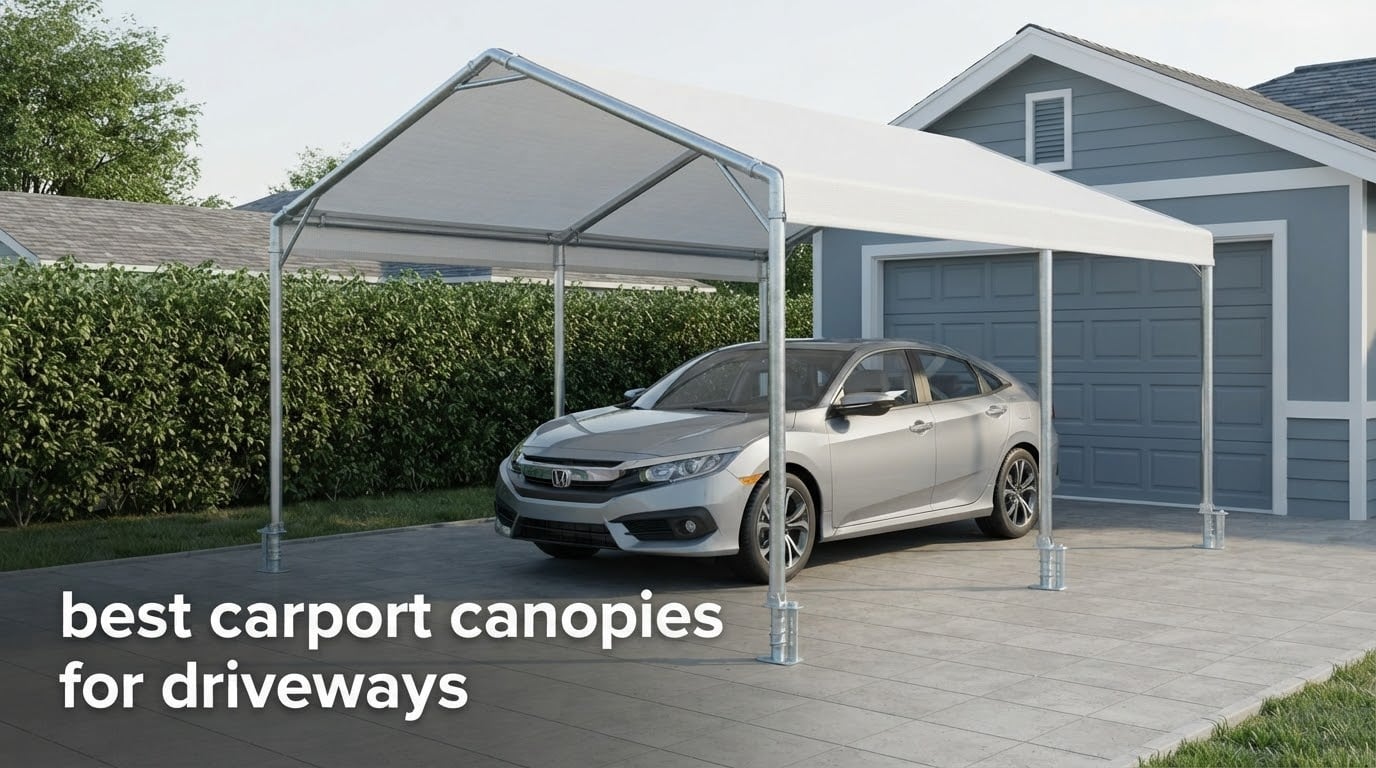
The best carport canopy for a driveway is a galvanized steel frame with a pitched roof, anchored properly for your pavement, and sized with about a foot of clearance on each side of the vehicle. If your main problem is sun and UV, a polyethylene canopy on an alloy steel frame covers it cheaply. If you get snow or hail, a metal-roof or cable-reinforced frame is worth the extra effort.
That is the short version after we spent weeks comparing eight driveway carport canopies across frame material, roof load ratings, clearance height and anchoring requirements. The ADVANCE OUTDOOR 10×20 came out ahead for most homeowners, but the right pick changes fast depending on whether you park a sedan or a camper, and whether you live in Phoenix or Maine.
This guide is for anyone without a garage who parks outside every night. It covers how to measure a driveway before you buy, what each frame material actually does for you, how to anchor the structure so a gust does not take it, and which permits you may need. We updated it for 2026 and every pick below reflects the current spec sheets and owner feedback we could verify.
One quick note before we start. If you already own a pop-up canopy for parties, our guide to the best pop up canopies for events covers a lighter duty category. Anything you park a car under needs a framed structure, not a folding tent. And if the canopy is going on a driveway that also has to host a hoop or a snow pile this winter, our picks on basketball hoops for driveways and snow blowers for driveways will help you plan the layout so the structures do not fight each other.
Table of Contents
- Top 3 Picks for Best Driveway Carport Canopies (October 2026)
- Best Carport Canopy Comparison Table in 2026
- 1. ADVANCE OUTDOOR 10×20 Heavy Duty Carport: Best Overall
- 2. Quictent 10×20 Heavy Duty Carport Canopy: Budget Pick
- 3. Quictent 10×20 Carport with Side Zipper Doors: Best for Snow and Wind
- 4. AirWire 10×15 Metal Carport Canopy: Best Bolted All-Metal Frame
- 5. Quictent 20×20 Heavy Duty Metal Carport: Best for Heavy Snow
- 6. COBIZI 12×20 Heavy Duty Carport: Best for All-Weather Enclosure
- 7. Wisteria Lane 20×20 Metal Carport: Best for Boats and Trucks
- 8. PHI VILLA 13×24 Portable Garage: Best for Storage and Equipment
- How to Choose a Carport Canopy for Your Driveway
- What a Carport Canopy Does and Does Not Protect Against
- Anchoring a Carport Canopy on Asphalt, Concrete or Soil
- Do You Need a Permit for a Driveway Carport?
- Frequently Asked Questions
- The Best Carport Canopy for Driveways in 2026
Top 3 Picks for Best Driveway Carport Canopies (October 2026)

ADVANCE OUTDOOR 10×20
- Galvanized steel frame
- Triple-layer 180g PE cover
- Adjustable 9.5-11 ft peak

Quictent 10×20 Zipper Doors
- 12 cross cables
- 9 lbs per sq ft snow load
- 40 mph wind rating
As an Amazon Associate we earn from qualifying purchases. CERTAIN CONTENT THAT APPEARS ON THIS SITE COMES FROM AMAZON. THIS CONTENT IS PROVIDED 'AS IS' AND IS SUBJECT TO CHANGE OR REMOVAL AT ANY TIME.
Best Carport Canopy Comparison Table in 2026
| Product | Key Features | Action |
|---|---|---|
|
ADVANCE OUTDOOR 10×20 Heavy Duty Carport
|
|
Check Latest Price |
|
Quictent 10×20 Heavy Duty Carport Canopy
|
|
Check Latest Price |
|
Quictent 10×20 Carport with Side Zipper Doors
|
|
Check Latest Price |
 AirWire 10×15 Metal Carport Canopy
|
|
Check Latest Price |
 Quictent 20×20 Heavy Duty Metal Carport
|
|
Check Latest Price |
 COBIZI 12×20 Heavy Duty Carport
|
|
Check Latest Price |
 Wisteria Lane 20×20 Metal Carport
|
|
Check Latest Price |
 PHI VILLA 13×24 Portable Garage
|
|
Check Latest Price |
As an Amazon Associate we earn from qualifying purchases, at no additional cost to you. CERTAIN CONTENT THAT APPEARS ON THIS SITE COMES FROM AMAZON. THIS CONTENT IS PROVIDED 'AS IS' AND IS SUBJECT TO CHANGE OR REMOVAL AT ANY TIME.
1. ADVANCE OUTDOOR 10×20 Heavy Duty Carport: Best Overall
ADVANCE OUTDOOR 10×20 ft Heavy Duty Carport Potable Car Canopy Garage Party Tent Boat Shelter, Adjustable Height from 9.5 ft to 11 ft, White
240 x 120 x 132 inch
Alloy steel frame
Triple-layer 180g PE cover
White
Pros
- Fast tool-free setup for two adults
- 1.5 inch galvanized poles with 8 solid legs
- Four side heights from 6.5 to 8.0 ft
- Waterproof anti-UV cover
- Responsive parts service
Cons
- Included stakes are too light for this span
- Fabric degrades after long sun exposure
- No replacement tops sold separately
As an Amazon Associate we earn from qualifying purchases, at no additional cost to you. CERTAIN CONTENT THAT APPEARS ON THIS SITE COMES FROM AMAZON. THIS CONTENT IS PROVIDED 'AS IS' AND IS SUBJECT TO CHANGE OR REMOVAL AT ANY TIME.
This is the one we kept coming back to. The frame is 1.5 inch diameter galvanized tubing on eight solid legs, which is heavier than most shelters in this price class, and the cover is a heat-sealed triple-layer 180g polyethylene that is genuinely waterproof rather than merely water resistant.
Height is the underrated feature here. Four side-wall settings run from 6.5 to 8.0 ft, giving a peak between 9.5 and 11.0 ft, so the same frame covers a sedan and a full-size pickup once you re-set the legs. The listed footprint is 240 by 120 by 132 inch and the floor area is 200 square feet.
Our team put it together in about half an hour with two people and no tools, which matches what owners report most often. The bungee and clip routing is where people get stuck, so budget extra time for that step rather than the frame itself. Owner feedback also credits the frame with holding through gusts above 50 mph once it is anchored properly.
The one thing we would change is the hardware bag. The 16 steel pegs and 8 auger anchors that come in the box are noticeably light for a 200 square foot shelter, and reviewers consistently report buying heavier ground anchors. Treat the included kit as a starting point, not a finished anchoring solution.
How much clearance do you actually get
With the legs at their lowest the side walls sit at 6.5 ft, which clears most sedans and crossovers with room to spare. At the highest setting the side walls reach 8.0 ft, and the 9.5 to 11.0 ft peak gives taller vehicles and roof racks real headroom.
Because you can move the legs after assembly, this one shelter can follow you from a family sedan to a full-size truck without buying a second frame. Measure your tallest vehicle including any roof rack or antenna before you pick a setting.
Where this shelter falls short
The polyethylene cover is the weak point over a long horizon. Owners report the fabric going thin and tearing at the seams after extended direct sun, and the manufacturer does not sell a replacement top on its own, so a tired cover usually means a new shelter. If you are in a high-UV region, plan for a cover replacement every few seasons or move up to a metal roof.
It also has no sidewalls, which keeps it cheap and improves airflow but means wind-driven rain still reaches the car. The warranty is one year on poles and covers, with lifetime coverage on accessories.
As an Amazon Associate we earn from qualifying purchases, at no additional cost to you. CERTAIN CONTENT THAT APPEARS ON THIS SITE COMES FROM AMAZON. THIS CONTENT IS PROVIDED 'AS IS' AND IS SUBJECT TO CHANGE OR REMOVAL AT ANY TIME.
2. Quictent 10×20 Heavy Duty Carport Canopy: Budget Pick
Quictent 10×20 ft Heavy Duty Carport Canopy Galvanized Car Tent Outdoor Garage Boat Shelter with Reinforced Structure, No Sidewall, Green
240 x 120 x 110 inch
Alloy steel frame
Green
no sidewall
Pros
- Reinforced top poles resist twisting
- Easy two-person assembly
- Sturdy galvanized tubing for the money
- Quick replacement part support
Cons
- Side height is tight for full-size pickups
- Top cover can split along its length
- Corner welds sometimes arrive broken
As an Amazon Associate we earn from qualifying purchases, at no additional cost to you. CERTAIN CONTENT THAT APPEARS ON THIS SITE COMES FROM AMAZON. THIS CONTENT IS PROVIDED 'AS IS' AND IS SUBJECT TO CHANGE OR REMOVAL AT ANY TIME.
This is the budget-friendly answer, and the reason it outscores so many shelters in its class is the reinforced top poles. Quictent doubled up on the roof-line tubing specifically to resist twisting, which is the failure mode that turns cheap frames into wobbling hulks after a season.
Coverage is 200 square feet at 240 by 120 inch, and the listed height is 110 inch. Assembly is a two-person job and some owners erect it alone. Customer service comes up repeatedly in reviews as a genuine strength, with replacement parts shipped fast when something is missing or cracked.
Owners describe it as a solid, economical shelter that handles normal sun and rain without drama. The rating sits at 4.1 across a large review base, and the distribution is honest: most five-star reports are about value and ease of build rather than long-term durability.
The recurring complaints are specific. Side height is low enough that a full-size pickup can clip the top cross pole on entry, the cover is snug enough to split along its length after limited weathering, and a few buyers received corner connectors with cracked welds. Check the frame for cracks before you assemble anything.
Is it big enough for a truck
For a sedan, a hatchback or a mid-size SUV, the footprint is comfortable. For a full-size pickup with a crew cab, the 110 inch listed height is the deciding factor rather than the 200 square feet of floor area. Measure door height with the tailgate down if you plan to load anything.
The 20 ft length does give you room to pull in straight and exit without reversing into traffic, which is the part people underestimate when they compare shelter dimensions to their vehicle.
Where this shelter falls short
Because there is no sidewall, this is a sun and rain shield only, and the cover can act like a sail if it stays up in an exposed or storm-prone spot. Owners in coastal and open-area sites report the fabric tearing sooner than the frame fails. If wind is your main worry, move up to a cable-reinforced enclosed design.
Instructions cover several tent models at once, so budget time to find the pages for your specific unit. The cover is also sold as a full top rather than a replacement panel, which matters if you want to keep the frame for years.
As an Amazon Associate we earn from qualifying purchases, at no additional cost to you. CERTAIN CONTENT THAT APPEARS ON THIS SITE COMES FROM AMAZON. THIS CONTENT IS PROVIDED 'AS IS' AND IS SUBJECT TO CHANGE OR REMOVAL AT ANY TIME.
3. Quictent 10×20 Carport with Side Zipper Doors: Best for Snow and Wind
Quictent 10×20 ft Carports with Side Zipper Doors
236 x 118 x 118 inch
Steel frame
16 mil PE cover
Gray
Pros
- Rated for 9 lbs per sq ft of snow
- 40 mph wind rating
- Triple-stitched 180g cover
- Mesh windows cut condensation
- Tool-free build in about an hour
Cons
- Heavier and bulkier than open canopies
- Sidewalls reduce airflow
As an Amazon Associate we earn from qualifying purchases, at no additional cost to you. CERTAIN CONTENT THAT APPEARS ON THIS SITE COMES FROM AMAZON. THIS CONTENT IS PROVIDED 'AS IS' AND IS SUBJECT TO CHANGE OR REMOVAL AT ANY TIME.
This is the only shelter in our group with a published wind rating and a published snow load, which is exactly why we recommend it for anyone north of the Mason-Dixon line. The 12 cross-steel cables are rated for 9 lbs per square foot of snow and 40 mph winds. That is a real number you can check your local code against.
It is also the most enclosed design we tested. Roll-up zipper doors sit on each side panel plus the front and rear, so you can open one wall for access without unzapping the whole structure. Four mesh windows, two per side, sit behind PE window covers so you keep shade and privacy while cutting condensation.
Owners highlight the reinforced cable frame, the thickened 180g cover with triple-stitched seams and how simple the labeled tool-free assembly is. Roughly 73% of reviews are five star, the highest share of any shelter here, and the 4.4 average reflects a build that feels more considered than its fabric category usually does.
The cover is 16 mil PE, waterproof and fully UV blocking, which is what makes the enclosed approach worthwhile in a sunny climate too. The listed dimensions are 236.22 by 118.11 by 118.11 inch over 200 square feet of coverage.
Does it really handle snow
It handles what it claims. The 9 lbs per square foot rating is roughly the load of a moderately snowy single-season snowfall spread across the roof, and the cable reinforcement is what keeps the frame from racking sideways as weight builds. Owners in snowy areas report the vertical walls staying square through the season.
You still need to knock heavy wet snow off during a storm, because no fabric carport is designed to carry a loaded shovel. The difference is that this one starts from a number rather than a hope.
Where this shelter falls short
The main tradeoff is bulk. A fully enclosed footprint is heavier and less breathable than an open-sided canopy, and the sidewalls do reduce usable ventilation even with the mesh windows. In a hot climate, a sealed shelter can trap heat around the vehicle on still days, so plan to open at least one panel when parked for long periods.
It is also not the lightest option to move around a driveway. If you plan to take it down for winter and put it back up in spring, that added weight is a real consideration.
As an Amazon Associate we earn from qualifying purchases, at no additional cost to you. CERTAIN CONTENT THAT APPEARS ON THIS SITE COMES FROM AMAZON. THIS CONTENT IS PROVIDED 'AS IS' AND IS SUBJECT TO CHANGE OR REMOVAL AT ANY TIME.
4. AirWire 10×15 Metal Carport Canopy: Best Bolted All-Metal Frame
AirWire 10×15 FT Metal Carport Canopy with Reinforced Base
173.4 x 122.2 x 106.7 inch
Square steel tubing
Metal roof
209 lb
Pros
- Bolted joints stay rigid after reassembly
- Reinforced square tubing with good welds
- Metal roof needs no annual replacement
- Two people finish in about half a day
Cons
- Roof panels leak at the seams
- Panels crease and do not reshape
- Included ground anchors are not usable
- Instructions are thin on sealing
As an Amazon Associate we earn from qualifying purchases, at no additional cost to you. CERTAIN CONTENT THAT APPEARS ON THIS SITE COMES FROM AMAZON. THIS CONTENT IS PROVIDED 'AS IS' AND IS SUBJECT TO CHANGE OR REMOVAL AT ANY TIME.
This is the frame-first option. Instead of screws, the connections are bolted, and the square steel tubing is reinforced at 11 key locations. That distinction sounds small until you take the shelter apart and put it back up, which is when bolted joints are still square and screwed ones rack.
It is also a metal roof, which means no annual fabric replacement. The roof panels overlap along the length for added strength, and there are waterproof sealant strips along the roof with soft rubber edges. Sizes run from 10×15 ft up to 20×40 ft, so the same product line covers a single car or a small fleet.
Owners consistently call the frame engineering better than similarly priced fabric carports, and the welds get specific praise. Two people can complete assembly in roughly half a day. Customer service is also strong here, including replacement roof panels when a panel creases in a storm.
The 10×15 ft version is 173.4 by 122.2 by 106.7 inch and weighs 209 pounds, so lifting the roof onto the legs genuinely needs two strong people. Check the panel overlap direction against your prevailing wind before you bolt the roof on, because that is what determines where water runs.
What the metal roof changes
A metal roof is the single biggest upgrade for year-round use. It does not UV-degrade, it sheds water and snow instead of absorbing it, and it will outlast a comparable vinyl canopy by years. The cost is that panels dent, and a creased panel is hard to reshape.
Buyers who add a line of caulk or silicone along the seams report the leak complaints disappearing. If you are willing to spend twenty minutes sealing after assembly, this roof rewards it.
Where this shelter falls short
Seams are the weak point. The included washers and weatherproof tape draw consistent criticism, and a few owners reported water intrusion at panel joins in heavy rain before adding sealant. The instructions are mostly photos and do not clearly show where the sealing tape goes, so plan to work that out yourself.
Do not rely on the supplied ground anchors. Owners in windy areas report that they are essentially decorative and that additional anchoring is mandatory. This is also a top-only shelter, so wind-driven rain still reaches the vehicle from the sides.
As an Amazon Associate we earn from qualifying purchases, at no additional cost to you. CERTAIN CONTENT THAT APPEARS ON THIS SITE COMES FROM AMAZON. THIS CONTENT IS PROVIDED 'AS IS' AND IS SUBJECT TO CHANGE OR REMOVAL AT ANY TIME.
5. Quictent 20×20 Heavy Duty Metal Carport: Best for Heavy Snow
Quictent 20×20 FT Heavy Duty 2-Car Metal Carport, Galvanized Steel Hard Top SUV/Truck Parking Shelter with Reinforced Triangle Frame, Weatherproof Rust-Resistant Car Canopy for Vehicle & Boat, White
242 x 236 x 131 inch
Metal frame
Galvanized steel roof
White
Pros
- 35 PSF load capacity for two vehicles
- Triple-layer rustproof roof
- Vertical roof drains fast without clearing
- Eaves add shade coverage
- Laser-cut pre-drilled frame holes
Cons
- About 677 lb so assembly needs several people
- 6 to 8 hour install even with pre-drilled holes
- Local wind and snow codes vary
As an Amazon Associate we earn from qualifying purchases, at no additional cost to you. CERTAIN CONTENT THAT APPEARS ON THIS SITE COMES FROM AMAZON. THIS CONTENT IS PROVIDED 'AS IS' AND IS SUBJECT TO CHANGE OR REMOVAL AT ANY TIME.
If you have two vehicles and real snow, this is the shelter built for the job. The 35 PSF load capacity comes from 6 reinforced crossbars and 18 triangle beams, which is a genuinely different engineering class from the cable-and-fabric designs. The roof is galvanized steel with an anti-corrosion coating and UV-resistant paint on top.
The vertical roof design is worth understanding. Rather than a shallow pitch, water and snow run off quickly along the panel direction, which means far less accumulation and no need to climb up and clear it after a storm. The same feature keeps water from pooling in low spots, the most common complaint owners report with flatter portable canopies.
Coverage is 400 square feet across 242.13 by 236.22 by 131.1 inch, so two full-size vehicles fit with room to walk between them. Anti-corrosion screws and rubber gaskets along the seams are the detail that keeps a metal roof from leaking, and expansion anchor bolts are included in the box.
Owners also credit the laser-cut pre-drilled holes, which reportedly halve assembly time compared with self-drilling frames. Extended side eaves add usable shade on both sides, which is a bigger deal than it sounds in summer.
What 35 PSF actually means for you
Pounds per square foot is how much load the roof structure carries per unit of area. At 35 PSF over 400 square feet, this frame is rated for far more than typical seasonal snow accumulation, which is why it is the pick for northern driveways and for anyone who does not want to touch the roof in a storm.
Compare that to a fabric canopy rated in the single digits, and the gap in storm survivability becomes obvious. It does not make any shelter maintenance-free, but it changes how often you have to think about it.
Where this shelter falls short
At roughly 677 pounds this is by far the heaviest shelter in the group, and the listed weight reflects real freight. Assembly realistically needs several people and a clear driveway, and even with pre-drilled holes owners budget six to eight hours. Budget a weekend and recruit help before the first box arrives.
It also carries the lowest average rating here at 4.0, with a wider spread of scores than the fabric models. That is mostly the weight and assembly burden showing up in reviews rather than build quality. Finally, local wind and snow load codes vary, so confirm the rating against your municipality before buying.
As an Amazon Associate we earn from qualifying purchases, at no additional cost to you. CERTAIN CONTENT THAT APPEARS ON THIS SITE COMES FROM AMAZON. THIS CONTENT IS PROVIDED 'AS IS' AND IS SUBJECT TO CHANGE OR REMOVAL AT ANY TIME.
6. COBIZI 12×20 Heavy Duty Carport: Best for All-Weather Enclosure
COBIZI Carport 12×20 Heavy Duty Storage Shelter Shed Portable Garage with All-Steel Metal Frame & Vents, Round Style Outdoor Storage Shed for Car, Truck, Boat, Waterproof Carport Canopy Anti-Snow
240 x 144 x 117.6 inch
Hot-dip galvanized pipes
Waterproof fabric
Dark gray
Pros
- Highest five-star share in our group at 79%
- 10 hot-dip galvanized pipes with foot plates
- Thick industrial-grade fabric
- Removable double-zipper front and rear doors
- 4 ventilation openings
Cons
- Round frame gives less overhead clearance
- 12x20 all-in-one footprint suits cars more than tall vehicles
As an Amazon Associate we earn from qualifying purchases, at no additional cost to you. CERTAIN CONTENT THAT APPEARS ON THIS SITE COMES FROM AMAZON. THIS CONTENT IS PROVIDED 'AS IS' AND IS SUBJECT TO CHANGE OR REMOVAL AT ANY TIME.
This one scores highest on owner satisfaction. It carries a 4.5 average with 79% of reviews at five stars, the strongest satisfaction signal in the group, and the reason is a frame that does not feel like an afterthought: 10 hot-dip galvanized pipes, 10 foot plates, iron stakes and wind ropes, all included.
The round profile is a deliberate choice. A curved roof has no ridge seam to leak and no corners for wind to catch, and owners report the galvanized frame resisting bending, corrosion and rust. The trade is vertical room, which we will get to below.
The cover is a thickened industrial-grade fabric rated to resist tearing, fading, UV, wind, rain and snow, with connected sides and top rather than a loose tarp. Removable double-zipper doors with buckles open at both front and rear, and four ventilation openings cut the condensation that usually builds up in enclosed shelters.
Assembly is tool-light, with a one-piece cover that snaps on once the frame is up. Coverage is 240 square feet across 240 by 144 by 117.6 inch, which is wider than most 12-footers and useful for a car plus a boat or a pair of motorcycles.
When enclosed sides are worth it
Sidewalls change what the shelter does. Without them you get shade and top-down rain protection. With them you also block wind-driven rain, bird droppings, sap, pollen and roadside splash, which in a hail or dusty region is often the entire reason people buy one.
The four vents are what keep that enclosure from becoming a damp box. They are the difference between a shelter that smells musty after a rainy week and one that does not. Keep at least one vent clear and open a zipper door on still, sunny days.
Where this shelter falls short
The round roof profile means less usable overhead clearance than a peaked or gabled shelter, and that is the main geometry complaint in reviews. The 117.6 inch listed height suits cars, boats and equipment well, but a tall van or a pickup with a lifted suspension will feel the difference near the middle of the bay.
It is also a fairly large all-in-one footprint for a 12×20, so check your driveway width and your neighbor’s sightline before committing. Owners still love the galvanized frame quality, but the shape is a preference decision, not a universal win.
As an Amazon Associate we earn from qualifying purchases, at no additional cost to you. CERTAIN CONTENT THAT APPEARS ON THIS SITE COMES FROM AMAZON. THIS CONTENT IS PROVIDED 'AS IS' AND IS SUBJECT TO CHANGE OR REMOVAL AT ANY TIME.
7. Wisteria Lane 20×20 Metal Carport: Best for Boats and Trucks
Wisteria Lane Metal Carport, Carports 20×20 Heavy Duty with Thicker Frame and Base, UV-Resistant & Waterproof All-Weather Outdoor Shelter for Boats, Tractors, Pickup Trucks, Motorcycles, Dark Gray
281 x 233.7 x 126.9 inch
Iron tubing
Iron roof plates
Dark gray
Pros
- 6-side bracing with dual-reinforced bars
- 400 sq ft with about 127 inch height
- Owners report holding up through several storms
- Assembles simply with one helper
- Fast manual and parts support
Cons
- Not rated for heavy snow
- Ground stakes are severely inadequate
- Roof panel edges are very sharp
- Some pre-drilled holes do not align
As an Amazon Associate we earn from qualifying purchases, at no additional cost to you. CERTAIN CONTENT THAT APPEARS ON THIS SITE COMES FROM AMAZON. THIS CONTENT IS PROVIDED 'AS IS' AND IS SUBJECT TO CHANGE OR REMOVAL AT ANY TIME.
This is the big-footprint metal option, and the height is what separates it. At roughly 127 inches with 400 square feet of coverage across 281.04 by 233.76 inch, owners report fitting tall conversion vans that would scrape their roof racks on most portable canopies.
Structurally it uses high-strength square iron tubing with 6-side bracing and dual-reinforced top and bottom support bars plus lateral tubes, which is why owners report no swaying and frames that have held through several bad storms over months. The roof plates are 40% thicker than standard with rubber edging, waterproof strips and a UV-resistant coating.
It is also the easiest of the metal shelters to build, with several owners assembling it with a single helper. The hardware arrives in five organized packages with screws in a blister pack, and customer service supplies manuals and replacement parts promptly when something is missing.
Consider it for boats, tractors, pickup trucks and motorcycles as much as for cars. The 20×20 size gives you room to walk a boat trailer in straight without turning, which is the practical advantage over a 10×20 in a real driveway.
How it performs in a storm
Owners consistently report the frame surviving multiple bad storms, and the 6-side bracing is the reason. The lateral tubes are what stop the frame from racking side to side, and the dual reinforcement at top and bottom stops the classic bowed-header failure. This is genuinely a well-braced frame in a category full of flimsy ones.
The weak point is not the structure, it is the anchoring. Ground stakes in this kit are described in reviews as severely inadequate, so plan on adding your own before the first storm season rather than after.
Where this shelter falls short
It is not rated for heavy snow, and owners say so plainly. If your region gets real accumulation, this roof will need clearing that a 35 PSF frame would not. The roof panel edges are also very sharp, and the included knit gloves are not protective enough for handling them, so buy proper gloves.
Installation has rough edges. Some roof panels arrive with pre-drilled holes that do not line up with the frame, the panels bend easily if you force them, and the instructions omit two important points: the base must be completely level, and you should not tighten screws until every one is placed. Budget time to level the site carefully.
As an Amazon Associate we earn from qualifying purchases, at no additional cost to you. CERTAIN CONTENT THAT APPEARS ON THIS SITE COMES FROM AMAZON. THIS CONTENT IS PROVIDED 'AS IS' AND IS SUBJECT TO CHANGE OR REMOVAL AT ANY TIME.
8. PHI VILLA 13×24 Portable Garage: Best for Storage and Equipment
PHI VILLA 13x24ft Portable Garage Carport, Car Tents Storage Shed Canopy
288 x 156 x 115 inch
Galvanized steel pipe
220g PE fabric
Gray
Pros
- Largest footprint here at 312 sq ft
- Removable divider splits the interior
- Tool-free numbered assembly in about a day
- Double-zipper doors with reflective strips
- Double-layer mesh vents
Cons
- Not recommended above roughly 30 mph
- Fabric shrinks in strong sun and doors may not close
- Thinner than listing photos suggest
- Poorly written instructions
As an Amazon Associate we earn from qualifying purchases, at no additional cost to you. CERTAIN CONTENT THAT APPEARS ON THIS SITE COMES FROM AMAZON. THIS CONTENT IS PROVIDED 'AS IS' AND IS SUBJECT TO CHANGE OR REMOVAL AT ANY TIME.
This is less of a car shelter and more of a mobile garage, and owners treat it that way. The 13 by 24 ft gable footprint gives 312 square feet, the largest here, and reviewers report fitting a four-wheeler, a towable mower and a trailer inside with room to spare. A removable PE divider curtain runs down the center so you can split it into two zones.
The frame is 38mm galvanized steel pipe with elastic ball straps, and the cover is 220g PE fabric. Installed dimensions are 13 ft wide by 24 ft long by 9.6 ft high, with 6.6 ft of door clearance, and the unit weighs 200 pounds.
Assembly is tool-free with numbered components and takes about a day for two people. Roll-up dual-zipper doors with reflective strips at both ends make night access safer, double-layer mesh vents in each door cut condensation, and 4 S-shaped hooks inside give you somewhere to hang tools. Cement screws and ground nails are included.
Owners also note that it is larger than expected in person, which is worth factoring into your driveway planning. Sizes run from 6×10 ft up to 13×24 ft if you want a smaller footprint for a single motorcycle.
Is it big enough for a camper
At 9.6 ft of interior peak height and 6.6 ft of door clearance, it fits a small travel trailer and most pop-up campers. It does not fit a Class C motorhome or anything with a raised roof air conditioner, and the gable profile means the usable height drops quickly near the walls. Measure the tallest point of your camper including vents and antennas.
The 24 ft length is generous enough to pull a trailer in straight, which makes this a genuinely useful option for owners who want their camper and their car under one roof in a driveway that cannot spare two separate structures.
Where this shelter falls short
Wind is the clear limit. Owners are explicit that this model is not recommended above roughly 30 mph, which is a meaningfully lower ceiling than the cable-reinforced and 35 PSF designs. If you are in an open or storm-prone area, this is the wrong shelter regardless of how much you like the footprint.
The 220g PE fabric is thinner and shinier than the listing photos suggest, and it shrinks in strong sun, which can stop the doors from zipping fully closed. The instructions are poorly written and a few owners add zip ties after assembly to tighten components. Treat it as a storage and equipment shelter in a mild climate rather than an all-weather carport.
As an Amazon Associate we earn from qualifying purchases, at no additional cost to you. CERTAIN CONTENT THAT APPEARS ON THIS SITE COMES FROM AMAZON. THIS CONTENT IS PROVIDED 'AS IS' AND IS SUBJECT TO CHANGE OR REMOVAL AT ANY TIME.
How to Choose a Carport Canopy for Your Driveway
Choosing the right carport canopy comes down to seven decisions, in this order: measure the space, size the shelter to the vehicle, pick the cover material, check the roof pitch, verify a wind rating, confirm the anchor type suits your pavement, and check permit rules. Work through them in sequence and the purchase is straightforward.
Measure the driveway before you buy anything
Park the vehicle you intend to cover and measure its width and length, then add 12 inches of clearance on each side. For length, add enough room for your approach and exit angle, because entering a canopy at a shallow angle is how door mirrors and cross poles meet. Write those numbers down before you look at any product page.
Then measure the driveway itself, not just the vehicle. Check for overhead obstructions like low branches, eaves, and utility lines, and confirm the shelter will not block a neighbor’s view or sit against a shared property line. A 10×20 shelter needs roughly a 14 ft wide corridor to feel comfortable in daily use.
Match the shelter size to the vehicle
A compact sedan needs about 6.5 ft of side clearance and fits under a 10×20 with room for a second vehicle. A full-size SUV or pickup generally wants 8 ft or more of side height, which rules out several low-profile canopies. Camper and RV owners should look for 10 ft of interior peak height at minimum, and taller still if there is a roof air unit.
The number that catches people is door clearance rather than peak height. A gabled shelter is tall in the middle and short at the edges, so measure the height at the position where your door will actually be. Our 13×24 pick lists 9.6 ft peak but 6.6 ft at the door, and that gap decides whether a camper fits.
Decide on cover material
There are three real options. Polyethylene fabric on an alloy steel frame is the cheapest and easiest to assemble, blocks UV well, and needs replacing every few seasons in direct sun. Galvanized steel with a metal roof costs more and takes a full weekend, but it never needs a cover replacement and is the only option we would trust in heavy snow. Wood looks best and ages worst, since it warps and needs sealing annually.
On metal gauge, thicker is genuinely better. Look for square steel tubing rather than thin round pipe, and check whether frame connections are bolted instead of screwed. Bolted joints stay rigid after a disassemble and reassemble cycle, which matters if you plan to take the shelter down for winter and put it back up in spring.
Anchoring by driveway surface
On soil, use screw-in auger stakes driven at least 12 inches deep, one per leg, with a ratchet strap from each leg to a ground anchor beyond the frame. On asphalt, sandbags alone are not enough; use a drilled and pinned anchor or a purpose-built asphalt anchor driven into the edge of the slab. On a concrete slab, use expansion or wedge anchors at every foot plate, and never rely on the stakes that come in the box.
Wind is the number one failure cause reported by owners across driveway forums, and most of those failures trace back to anchoring rather than frame quality. The shelters that survive storms are the ones with anchors matched to the surface, and the ones that fail usually had the lightweight kit hardware that ships in the box.
Check local rules
Building departments differ on what triggers a permit, and the threshold is often size or whether the structure is attached to the house. A freestanding 10×20 may need nothing, while a 20×20 or an attached carport frequently does. Ask your local building department before you buy, and check your HOA rules separately, because HOA restrictions can be stricter than city code.
Build, buy a kit, or hire it out
A metal carport built from raw steel by a local fabricator gives you the strongest structure and the shortest path to a finished result, but it locks you into custom sizing and a permit from the start. A kit from a brand like Quictent or AirWire is cheaper and reversible, at the cost of a weekend of assembly and a weaker published wind rating on many models. Renting a crew to erect a kit is the middle path and the most common one we hear about.
For most homeowners the math is simple: the kit plus a day of labor is less than a fabricator build, and the shelter comes apart if you move. Choose the build route only if you need a structure that will stay through decades of snow, or if a fabricator can beat the kit on warranty.
What a Carport Canopy Does and Does Not Protect Against
A driveway canopy removes most of the daily exposure that damages paint, glass and interiors, but it is not a garage and it does not stop everything. Knowing the honest limits before you buy prevents a lot of disappointment, especially in storm-prone regions.
What it does protect against is straightforward. Direct UV on paint and dashboards, rain landing on a hood or roof, bird droppings, tree sap, pollen accumulation, falling debris, and in a metal-roof model, snow and hail. Sidewalls extend that to wind-driven rain and roadside splash. If sun damage is your main concern, which it is for most people, a basic top-only canopy solves it for a fraction of the cost of a garage.
What it does not protect against matters just as much. A top-only canopy does nothing about wind-driven rain hitting the sides of the car, or about sideways debris. A fabric canopy adds a sail effect, so a badly anchored shelter can become a projectile in a storm. A canopy also creates shade that traps heat, so a fully enclosed shelter in a hot climate can get uncomfortably warm around the vehicle on still days.
Most importantly, an anchored canopy is not storm-proof. The frames that fail do so because wind loads exceed what the anchors and frame can carry, and the resulting debris is more damaging than the weather was. If you live in a hail or high-wind zone, a metal roof with a real wind rating and proper anchors is the difference between protection and a liability.
Anchoring a Carport Canopy on Asphalt, Concrete or Soil
Anchoring is where most driveway canopies succeed or fail, and it is the single most common owner complaint across the forums we reviewed. The hardware in the box is almost always lighter than the shelter needs, so treat the included kit as a starting point.
On soil, screw-in auger stakes are the right answer. Drive one at every leg, at least 12 inches deep, then run a ratchet strap or guy line from each leg outward to an additional stake placed several feet beyond the frame corner. The outward angle is what stops the frame from lifting rather than just sliding.
On asphalt, sandbags alone will not hold a large canopy. Drill a hole, insert an asphalt anchor, and pin it with a headed bolt, or place a weighted base at each foot plate and ratchet from there. The key is preventing lift. If you cannot get into the slab, use a heavy weighted base rather than a small stake driven into the asphalt itself.
On a concrete slab, use expansion or wedge anchors at every foot plate and check the slab for cracking before you drill. On a shared or rental driveway, confirm in writing that you are allowed to drill before you start, because patching a bored slab is a bigger job than the canopy was.
Recheck every strap and anchor at the start of each storm season. Metal roof shelters expand and contract with temperature, which loosens fasteners over a year, and a strap that was snug in the spring is often slack by winter. Ten minutes of tension checking is cheaper than a replacement shelter.
Do You Need a Permit for a Driveway Carport?
You probably need a permit for a 20×20 carport, and you may need one for a 10×20 depending on where you live. The usual triggers are size, whether the structure is attached to your house, and whether it sits on a permanent foundation. Your local building department is the only authority that matters here.
What a permit usually involves is a simple site plan showing the shelter footprint on your lot, setbacks from property lines, and sometimes a wind and snow load calculation. Portable fabric canopies with no foundation are frequently exempt, which is one reason lightweight designs stay popular in permit-strict cities. Attached carports almost always need approval because they alter the house envelope.
HOA rules are a separate and often stricter layer. Some communities prohibit any structure visible from the street, restrict color to match the house, or ban covers entirely. Get the rules in writing before you assemble anything, because a shelter you have to take down is a wasted weekend and a refund you will not get.
Frequently Asked Questions
What is the best car shelter for a driveway?
The best car shelter for a driveway is a galvanized steel frame with a pitched or vertical roof, anchored to your pavement with auger stakes, asphalt anchors or concrete bolts. For sun and UV protection, a polyethylene cover on an alloy steel frame is enough. For snow, hail or storms, choose a metal roof or a cable-reinforced frame with a published wind rating and at least 8 feet of side clearance.
Do you need a permit for a 20×20 carport?
You most likely do. Permit requirements usually trigger on size, whether the structure is attached to the house, and whether it sits on a permanent foundation, and a 20×20 shelter with a metal roof commonly crosses that line. Portable fabric canopies with no foundation are often exempt. Contact your local building department for the actual rule in your city, and check HOA rules separately since they can be stricter.
What gauge metal is best for a carport?
Thicker square steel tubing beats thin round pipe, and bolted frame connections beat screws. Square tubing reinforced at multiple points resists the bowing and racking that ruin lighter frames, and bolted joints stay rigid even after you disassemble and reassemble the shelter. Also check the coating: hot-dip galvanized or galvanized steel with an anti-corrosion layer resists rust far better than plain alloy steel, especially in coastal or wet regions.
Will a carport canopy survive a storm?
Only if it is anchored for the surface it sits on. Wind is the top reported failure cause, and most failures trace back to the lightweight stakes and ropes that ship in the box rather than to frame quality. Use screw-in auger stakes on soil, drilled anchors or weighted bases on asphalt, and expansion bolts on a concrete slab, then recheck tension each season. A metal roof with a published wind rating is safer than fabric in any storm.
Is it cheaper to build a carport or buy a kit?
A kit is cheaper and reversible. A metal carport built from raw steel by a local fabricator gives you the strongest structure and a shorter path to a finished result, but it locks you into custom sizing and a permit. A branded kit costs less, comes apart if you move, and usually needs a weekend of assembly plus a second set of ground anchors. Rent a crew to erect the kit if you want the middle path.
The Best Carport Canopy for Driveways in 2026
The ADVANCE OUTDOOR 10×20 is our pick for the best carport canopies for driveways. It has the sturdiest frame in the portable class, four adjustable side heights, a genuinely waterproof triple-layer cover, and the largest owner base of anything we compared, which means the feedback you are reading is well tested.
Buy the Quictent zipper-door model if you get snow or wind and want a published rating, the 20×20 Quictent if you park two vehicles and never want to clear a roof, and the COBIZI 12×20 if you want full enclosure. Whichever you choose, buy your own anchors the same week it arrives, because that is the difference between a shelter that lasts ten years and one that lasts one storm.